21 Best AI Visibility Tools for 2026 (Tested & Ranked)
-min.png)
Our top picks for AI visibility tools are Peec AI for actionable citation intelligence, Ahrefs Brand Radar for SEO-integrated brand tracking, Semrush AI Visibility Toolkit for crawler audits, and Profound for enterprise agent analytics. We evaluated 21 specialized platforms plus Profound across ChatGPT, Perplexity, Google Gemini, Claude, and Google AI Overviews. Pricing spans from budget-friendly options starting at €20 per month for Rankscale and $24.95 for Waikay, to mid-tier solutions like Peec AI at €89 per month, up to custom enterprise deployments with Conductor and Botify. Every evaluated platform measures how answer engines cite your brand, which URLs serve as source references, how sentiment trends across models, and how your share of voice compares against direct competitors. Use this verified guide to choose the right AI visibility platform for your team size and optimization workflow as of September 2026.
These AI visibility tools cover Generative Engine Optimization (GEO) and Answer Engine Optimization (AEO) for Peec AI, Profound, Otterly, Semrush, Ahrefs Brand Radar, and other leading vendors in 2026. We compared engine coverage, citation tracking accuracy, pricing transparency, and source attribution depth. Whether your priority is alerting on brand sentiment drops, uncovering the specific third-party URLs that power Perplexity answers, or monitoring high-volume prompt queries across global markets, this guide provides the detailed data needed to shortlist the right software for your search strategy.
What is an AI visibility tool?
An AI visibility tool is software that tracks and measures how often, in what context, and through which citations a brand appears inside generative AI search answers. While traditional search engine optimization tools monitor numeric keyword ranks in blue-link SERPs, AI visibility tools evaluate unstructured natural language responses generated by models like ChatGPT, Perplexity, Google Gemini, Claude, and Google AI Overviews. These platforms automatically dispatch recurring prompt sets across varied consumer personas, geographical locations, and search intents. They analyze whether the AI model mentions the brand name, cites owned domain URLs or earned media coverage, ranks the brand favorably against competitors, and expresses positive or neutral sentiment. Furthermore, advanced AI visibility tools dissect the retrieval augmented generation pipeline to identify the specific third-party sources, documentation pages, and community forums that influence answer engine outputs, providing clear optimization pathways for marketing teams.
How to choose the right AI visibility tool
To choose the right AI visibility tool, marketing teams must evaluate model coverage, citation tracking depth, prompt capacity, and actionability against their operational budget. First, verify multi-engine coverage: the platform must monitor ChatGPT, Perplexity, Google Gemini, Claude, and Google AI Overviews simultaneously, because buyer discovery queries distribute across multiple conversational interfaces. Second, evaluate citation data granularity. The software should differentiate between unlinked brand mentions and direct clickable citation chips, while mapping the exact source URLs influencing each answer. Third, inspect update frequency and prompt scalability. Growth teams require daily tracking across dozens of localized prompts, whereas enterprise organizations need automated bot crawl logs, role-based access, and data exports into BigQuery or Looker. Finally, consider whether your team needs a pure measurement dashboard or an active recommendation engine that generates prioritized remediation tasks. Entry-level tools start under $30 per month, while enterprise platforms exceed $250 per month.
The Best AI Visibility Tools in 2026
The best AI visibility tools in 2026 provide transparent prompt execution, multi-engine coverage, citation source attribution, and competitor share of voice benchmarking. To establish this ranking, we tested 21 dedicated platforms plus Profound by executing standardized B2B and consumer queries across ChatGPT, Perplexity Pro, Google Gemini, Claude 3.5, and Google AI Overviews. We examined each vendor across four quantitative dimensions: accuracy in detecting brand mentions within synthesized prose, fidelity in extracting source URLs, update frequency across scheduled intervals, and pricing value relative to prompt volume. Tools like Peec AI and Otterly AI excel at converting citation deficits into prioritized fixes for marketing teams. In contrast, platforms such as Ahrefs Brand Radar and Semrush AI Visibility Toolkit connect AI citation discovery directly to massive traditional backlink indexes. The detailed reviews below outline exact engine support, proprietary features, verified starting pricing, and best-fit use cases for every platform.
1. Peec AI: Peec.ai Review, Pricing, and Alternatives
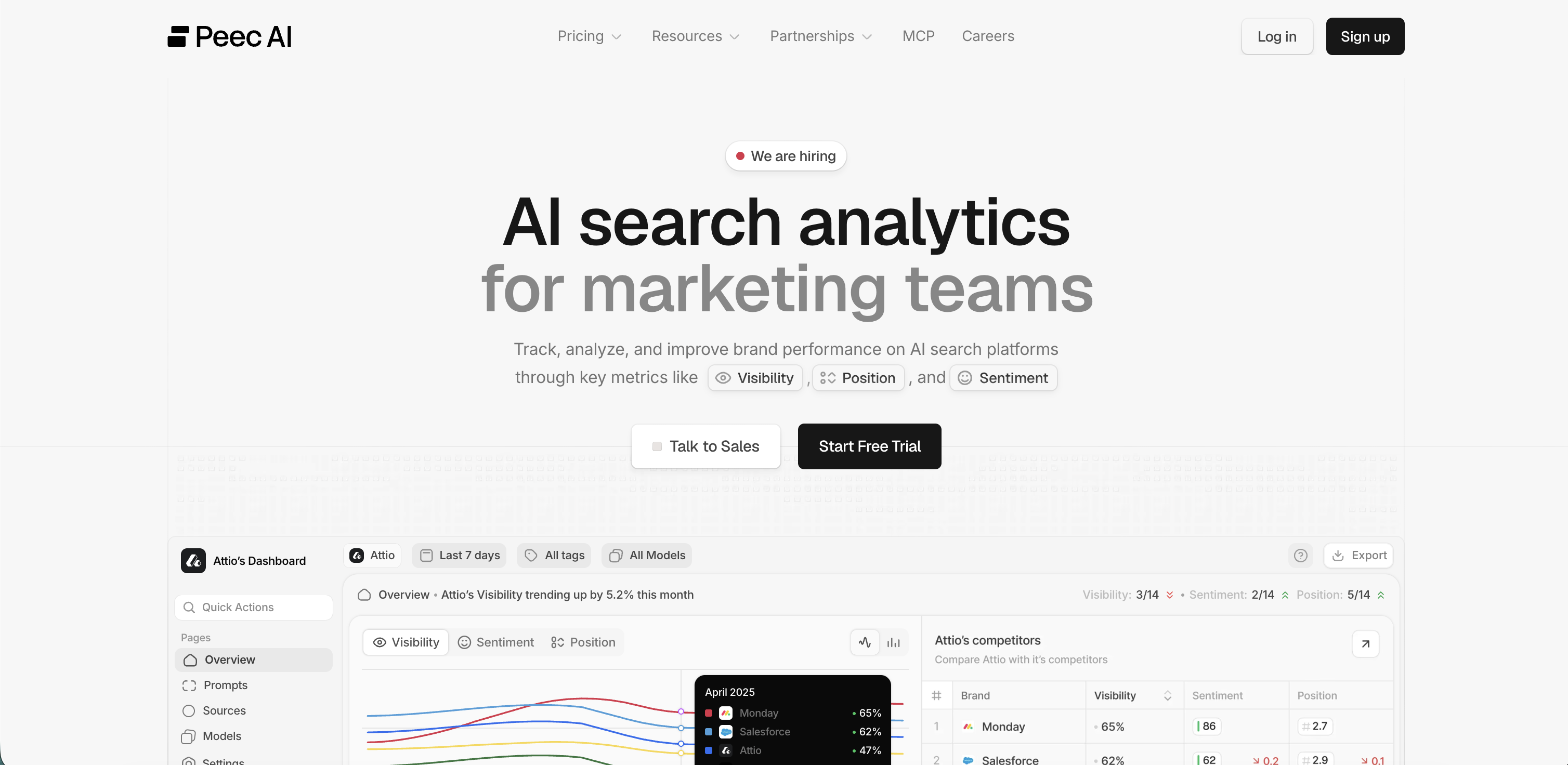
Peec AI , at peec.ai, is an AI visibility platform that tracks brand citations, prompt share of voice, and sentiment across ChatGPT, Perplexity, Gemini, Google AI Overviews, Google AI Mode, Claude, Copilot, and Qwen. Founded in Berlin in 2025 by Marius Meiners, Daniel Drabo, and Tobias Siwonia, the software serves over 3,000 marketing teams with offices in Berlin and New York. Features include clean real-time dashboards, unlimited user seats across all plan tiers, automated prompt discovery, competitor benchmarking, and an Actions view that categorizes optimization steps into owned content and earned media with assigned priority scores. Peec AI extracts exact source URLs influencing answer engine responses, showing teams precisely where competitors win citations. Alternatives include Ahrefs Brand Radar, Semrush AI Visibility Toolkit, and Profound. The platform is best for B2B, SaaS, and agency marketing teams that require actionable citation intelligence. Pricing starts at €89 per month with no seat restrictions.
2. AEO Vision: Research-First AI Visibility Platform
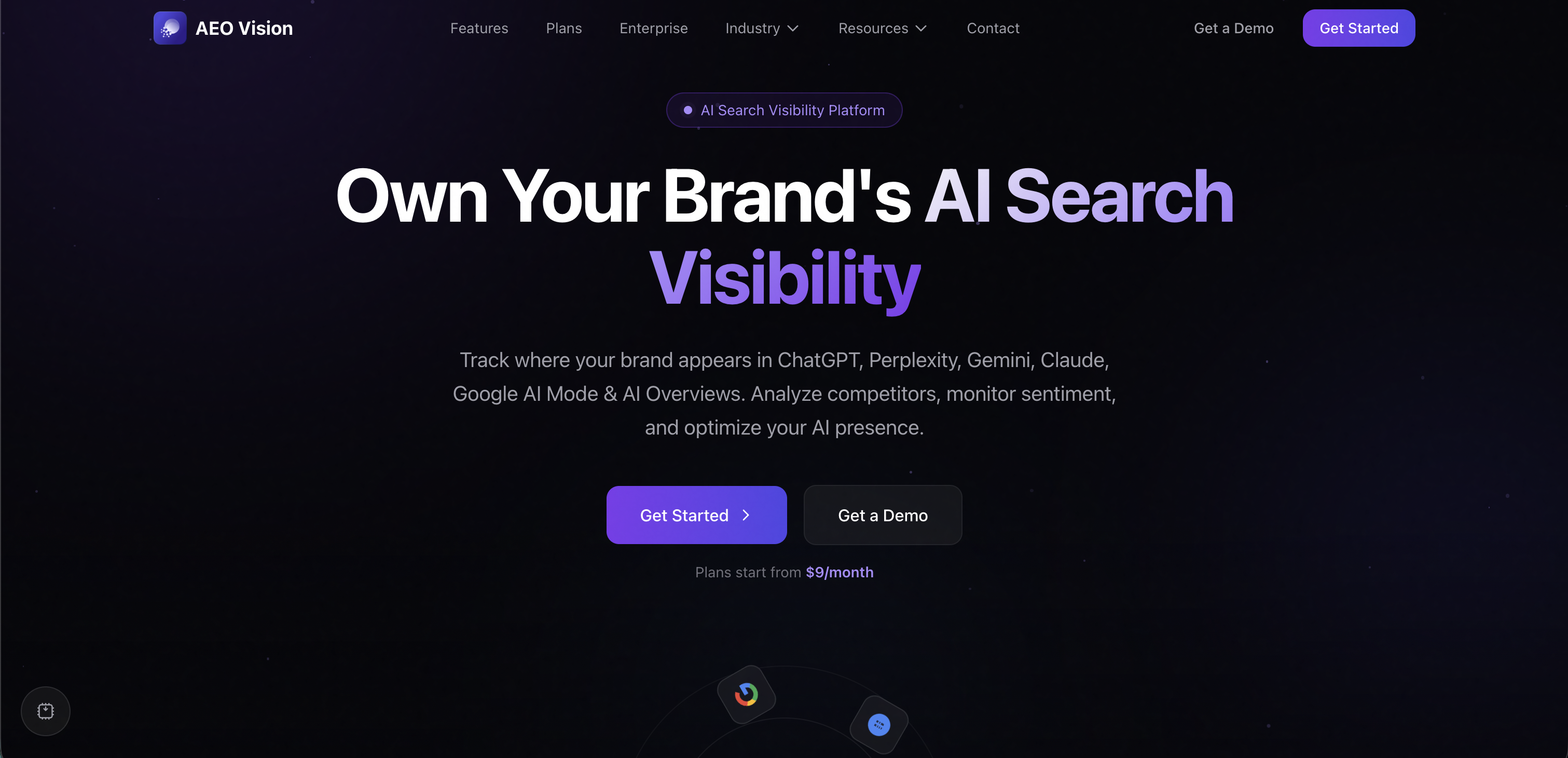
AEO Vision , at aeovision.ai, is a research-first AI visibility and optimization platform built specifically for answer engine optimization (AEO) and generative engine optimization (GEO). The platform tracks brand presence, sentiment, and citation chips across ChatGPT, Perplexity, Google Gemini, Claude, and Google AI Overviews. Standout features include citation-level prompt analytics, source domain clustering, and a strategy recommendation engine that translates visibility losses into targeted content revisions. Rather than merely presenting passive visibility metrics, AEO Vision maps user intent fanout to reveal which specific paragraphs, data points, and third-party references trigger LLM citations. This methodology enables content strategists and technical SEO teams to systematically close visibility gaps against category competitors. The software provides custom prompt suites, historical trend analysis, and comprehensive engine comparison charts. AEO Vision is best suited for technical SEOs, content directors, and digital agencies seeking deep analytical precision. Pricing is available on request with tailored onboarding plans.
3. Semrush AI Visibility Toolkit: Semrush.com Review and Pricing
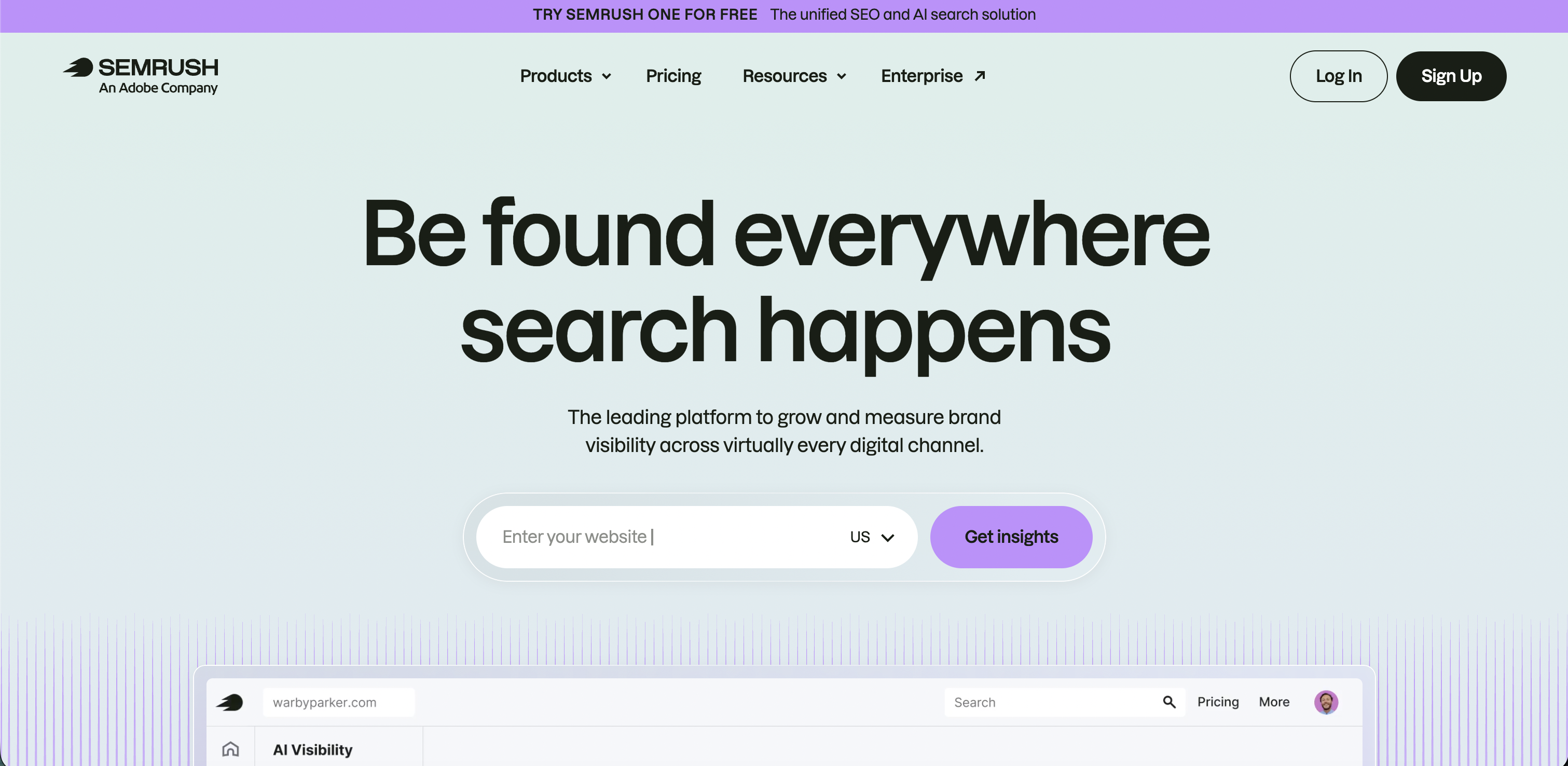
Semrush AI Visibility Toolkit , available at semrush.com, is an enterprise-grade extension to the Semrush suite designed for tracking AI Overviews and generative engine visibility. The platform tracks brand mentions, cited pages, sentiment distribution, and competitive share of voice across ChatGPT, Google Gemini, Google AI Overviews, and Google AI Mode. A standout capability is the AI Search Site Audit, which evaluates site crawlability and technical accessibility for major AI bot crawlers including GPTBot, PerplexityBot, and Google-Extended, identifying technical blockers that prevent LLM indexation. The toolkit connects AI visibility findings directly to Semrush's keyword research database and backlink intelligence, allowing teams to cross-reference organic rankings against generative citations. It translates complex model telemetry into executive-ready dashboards and automated alert notifications. The software is ideal for marketing teams already embedded in the Semrush ecosystem that require unified search reporting. Pricing for the AI Visibility Toolkit starts at $99 per month as an account add-on.
4. Ahrefs Brand Radar: AI Visibility Dashboard with Citation Data
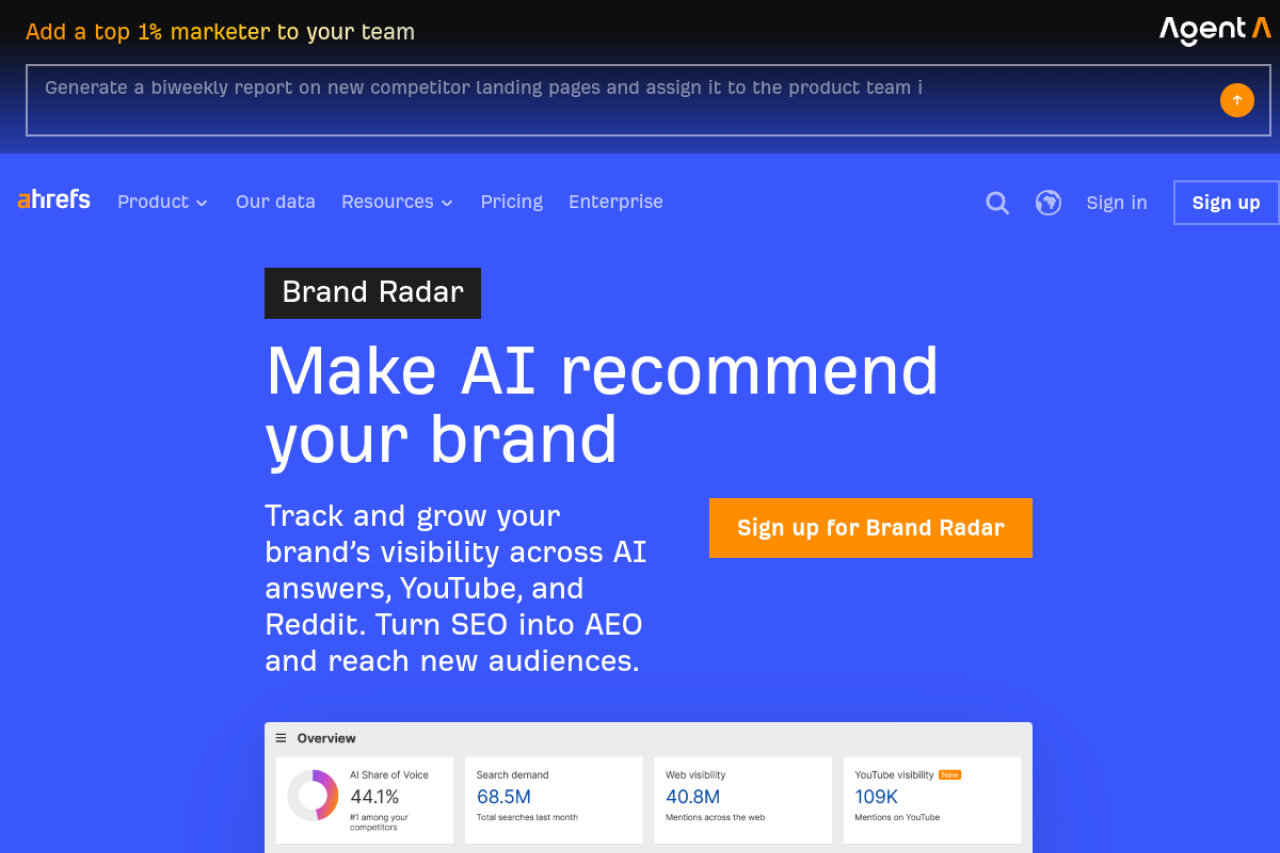
Ahrefs Brand Radar , available at ahrefs.com, is the dedicated generative search visibility module integrated into the core Ahrefs analytics suite. It monitors brand presence, citation frequency, and sentiment across ChatGPT, Claude, Gemini, Perplexity, Copilot, Grok, and Google AI Overviews. Operating against Ahrefs's massive index of multi-turn AI search queries, Brand Radar delivers immediate share of voice insights and historical trend lines without requiring complex manual prompt configuration. The platform cross-references cited source URLs with Ahrefs backlink data, Domain Rating (DR) metrics, and referring domains, highlighting external authority signals that power generative citations. In addition to web search answers, Brand Radar tracks social mentions across YouTube and TikTok to provide complete cross-channel brand monitoring. The tool excels at high-volume data aggregation and competitive domain benchmarking. It is best suited for established search teams and enterprise brands utilizing Ahrefs. Pricing is bundled into standard Ahrefs subscriptions, which start at $129 per month.
5. SE Ranking SE Visible: AI Visibility Tracker for Search Data
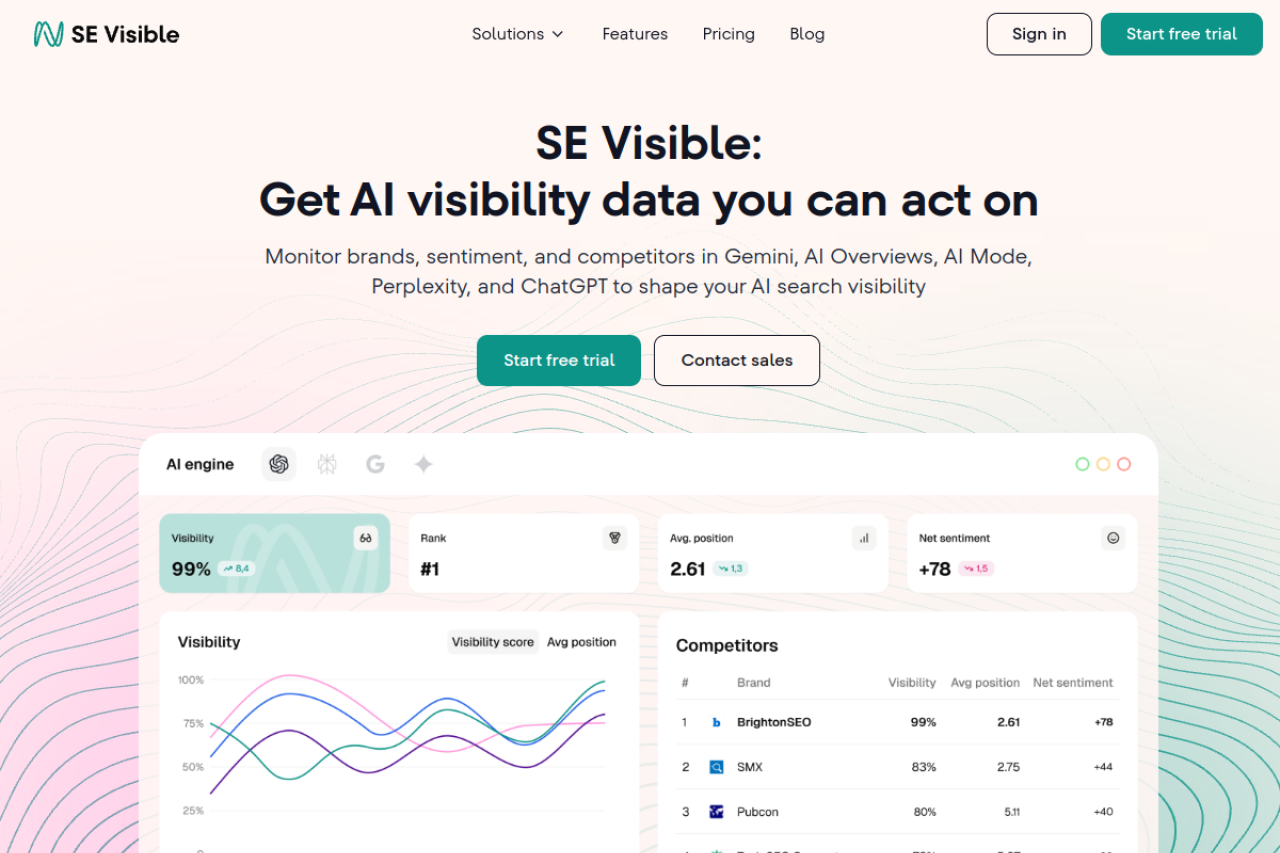
SE Visible , at visible.seranking.com, is an AI visibility tracker developed by SE Ranking that leverages over a decade of search intelligence infrastructure. The platform tracks brand mentions, citation chips, average ranking position, and competitive share of voice across ChatGPT, Perplexity, Google Gemini, and Google AI Mode. Features include pre-configured visibility scores, prompt-level sentiment classification, historical visibility charting, and automated source analysis identifying the top-cited domains in your niche. The interface simplifies complex generative search dynamics into straightforward KPIs, making it accessible for marketing directors and agency account managers without specialized technical training. Users can benchmark their brand presence against multiple industry rivals across localized markets and custom query groups. SE Visible integrates smoothly into existing SE Ranking agency reporting workflows and white-label client dashboards. The platform is best for digital marketing agencies, brand marketers, and mid-sized enterprises. Paid subscription plans for SE Visible start at $189 per month.
6. Scrunch AI: Security-First AI Visibility and Optimization Platform
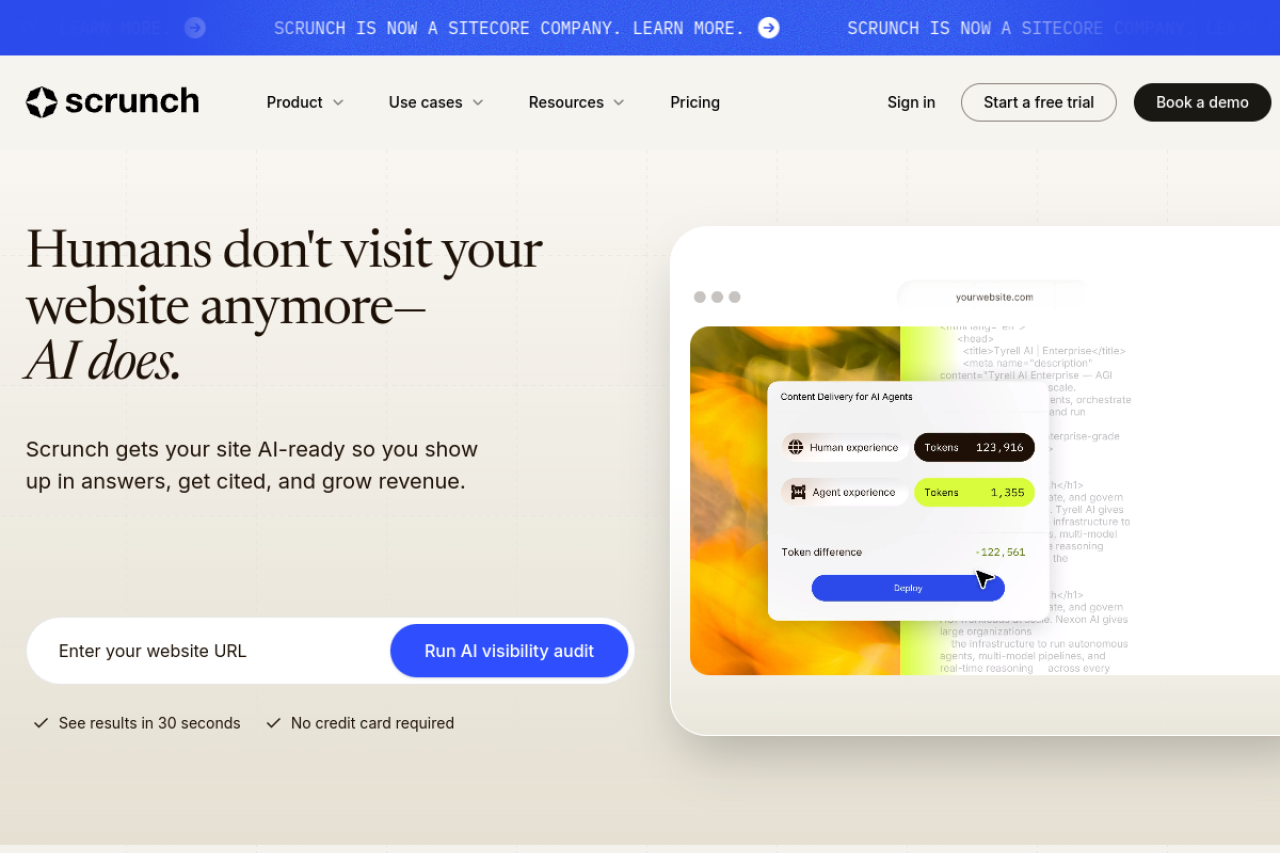
Scrunch AI , at scrunch.com, is an enterprise generative engine optimization and security-first AI visibility platform holding full SOC 2 Type II certification. The platform monitors major LLM search engines at granular prompt levels, enabling users to segment prompts by buyer persona, purchase stage, geographic region, and industry vertical. A standout capability is its real-time bot crawl feed, which logs exact visit timestamps, IP ranges, and request frequencies when GPTBot, PerplexityBot, and ClaudeBot crawl site assets. In addition, its Agent Experience Platform dynamically delivers lightweight, machine-readable representations of web pages directly to AI crawlers without requiring a total frontend overhaul. In June 2026, enterprise digital experience leader Sitecore acquired Scrunch AI for approximately $225 million, expanding its global engineering and enterprise integration capabilities. The software is best suited for regulated enterprise organizations, healthcare brands, and security-conscious marketing teams. Pricing begins at $100 per month for foundational tiers.
7. Otterly AI: Otterly.ai AI Search Monitoring Review and Pricing
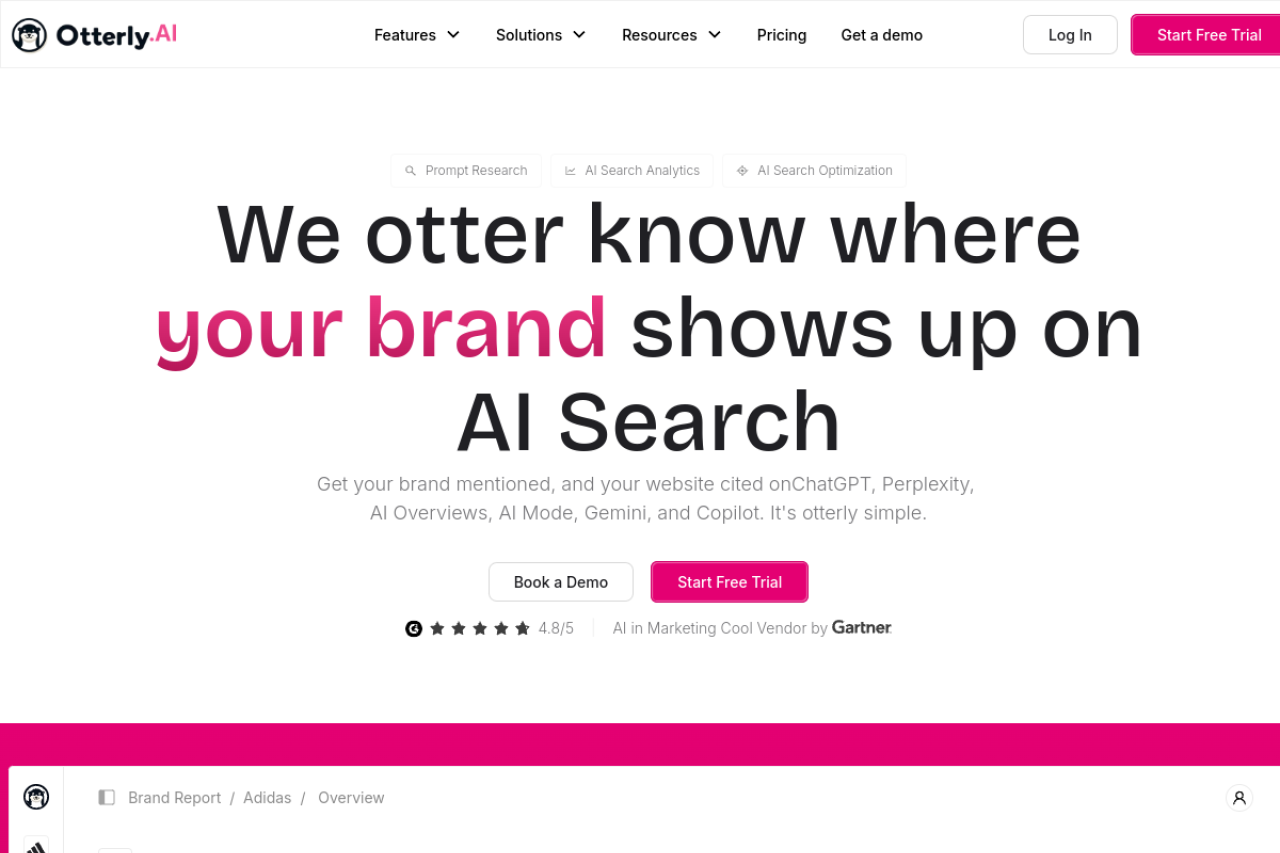
Otterly AI , at otterly.ai, is an automated AI search monitoring and generative engine optimization tool tailored for growth-stage businesses and PR teams. The platform tracks brand presence, sentiment, and cited sources across ChatGPT, Perplexity, and Google AI Overviews on scheduled daily cycles. It automatically translates target SEO keyword clusters into conversational natural language prompts, monitoring them continuously and dispatching real-time notifications when brand visibility or citation rankings drop. Its built-in automated GEO audit examines technical site foundations, flagging missing Schema.org markup, crawl blocks, and content formatting issues that hinder answer engine citation. Otterly AI also provides competitor displacement analysis, showing which rival domains captured your lost citation spots. The lightweight dashboard makes it easy to share stakeholder reports without steep learning curves. The tool is best for small to mid-size marketing teams, PR specialists, and communications agencies. Pricing starts at an accessible $29 per month.
8. Rankscale: Budget-Friendly AI-Native Rank Tracker
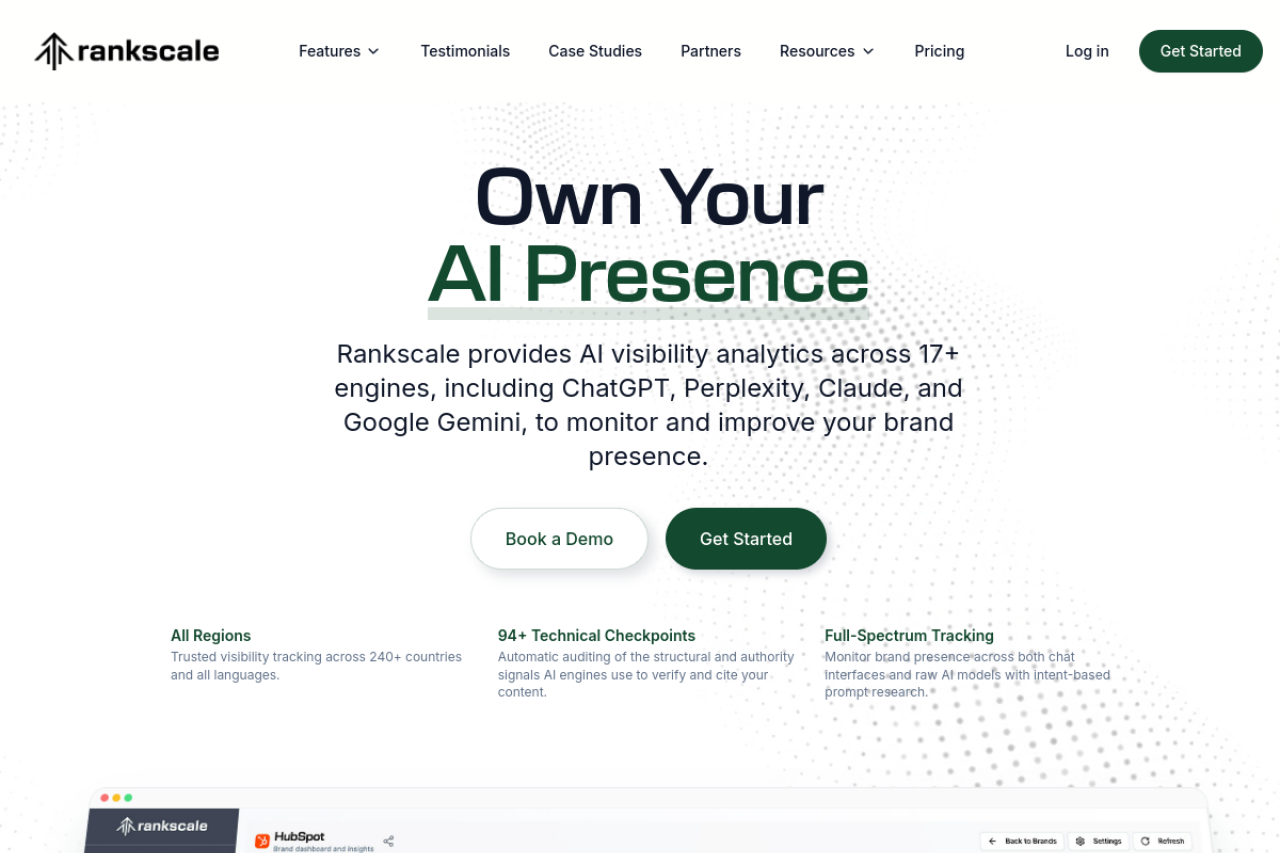
Rankscale , at rankscale.ai, is an AI-native rank tracking and generative search visibility platform designed specifically for lean marketing teams and SEO agencies. The tool provides a streamlined interface reporting aggregate visibility scores, average generative answer position, citation link tracking, and competitor benchmarking across leading AI models. Operating on a flexible credit-based consumption model, Rankscale allows agencies to monitor brand presence across hundreds of specialized prompts without rigid annual commitments. It includes white-label reporting capabilities, enabling consultants to generate customized PDF and web deliverables with agency branding for client presentations. The platform tracks how frequently answer engines cite specific URLs from owned domains versus third-party review sites and industry publications. While teams need separate content editors for drafting fixes, Rankscale excels at pure measurement efficiency. The platform is best suited for startups, boutique digital agencies, and independent search consultants. Subscription plans start at €20 per month, offering one of the lowest entry costs.
9. Conductor: Enterprise Answer Engine Optimization Platform
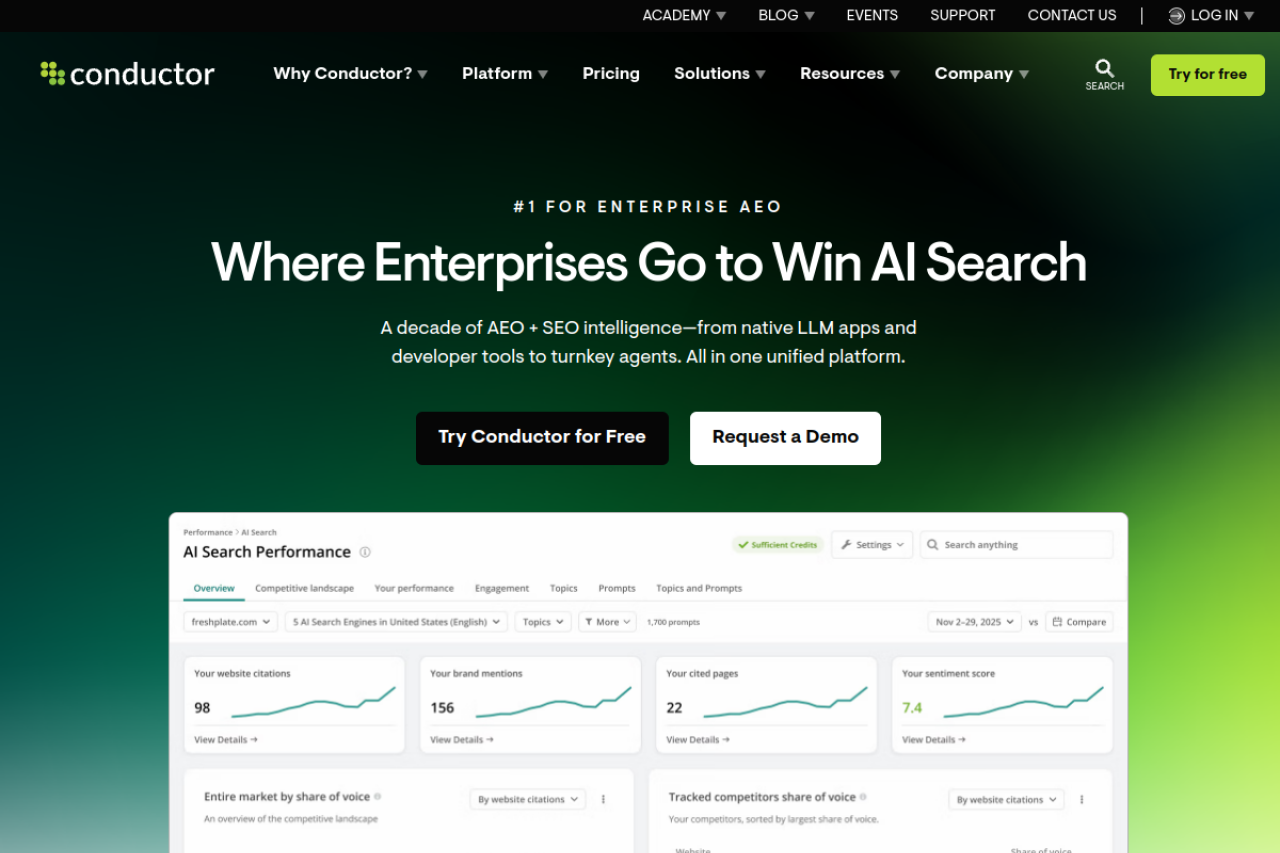
Conductor , at conductor.com, is an enterprise organic marketing and Answer Engine Optimization (AEO) platform uniting generative search intelligence, content creation, and technical SEO workflows. Conductor's proprietary AgentStack architecture analyzes brand visibility, citation distribution, and entity associations across ChatGPT, Perplexity, Google Gemini, and Google AI Overviews. The software bridges cross-functional marketing teams by integrating search intelligence with leading CMS platforms, digital asset managers, and enterprise analytics ecosystems like Adobe Analytics and Google Analytics 4. Conductor evaluates prompt intent across enterprise customer journey stages, alerting teams to competitive displacements and identifying authoritative content gaps that require strategic updates. In addition, it provides robust governance, multi-domain tracking, and enterprise-grade security protocols suitable for Fortune 500 organizations. The platform is best suited for large enterprise brands, global ecommerce companies, and corporate marketing departments with dedicated technical teams. Conductor provides custom annual contracts tailored to enterprise scale and query volume.
10. AthenaHQ: End-to-End AEO and GEO Platform
AthenaHQ , at athenahq.ai, is an end-to-end Answer Engine Optimization (AEO) and Generative Engine Optimization (GEO) platform that pairs automated visibility tracking with strategic execution workflows. The software monitors brand visibility, sentiment, and citation chips across ChatGPT, Perplexity, Google Gemini, and Claude. AthenaHQ stands out by calculating a proprietary Unified GEO Score that quantifies overall brand health across conversational search engines into a single actionable metric. Beyond observational metrics, the platform highlights high-priority content gaps, suggests prompt targets, and flags technical crawler accessibility issues that block AI bots from indexing key assets. For ecommerce retailers, AthenaHQ includes native Shopify integration that attributes AI search visibility shifts directly to product catalog page views and revenue impact. The platform provides automated weekly executive summaries and competitive displacement alerts. It is best suited for mid-market and enterprise ecommerce brands and performance marketing teams. Paid plans begin at $295 per month.
11. Writesonic GEO: Content Creation and AI Monitoring in One Platform
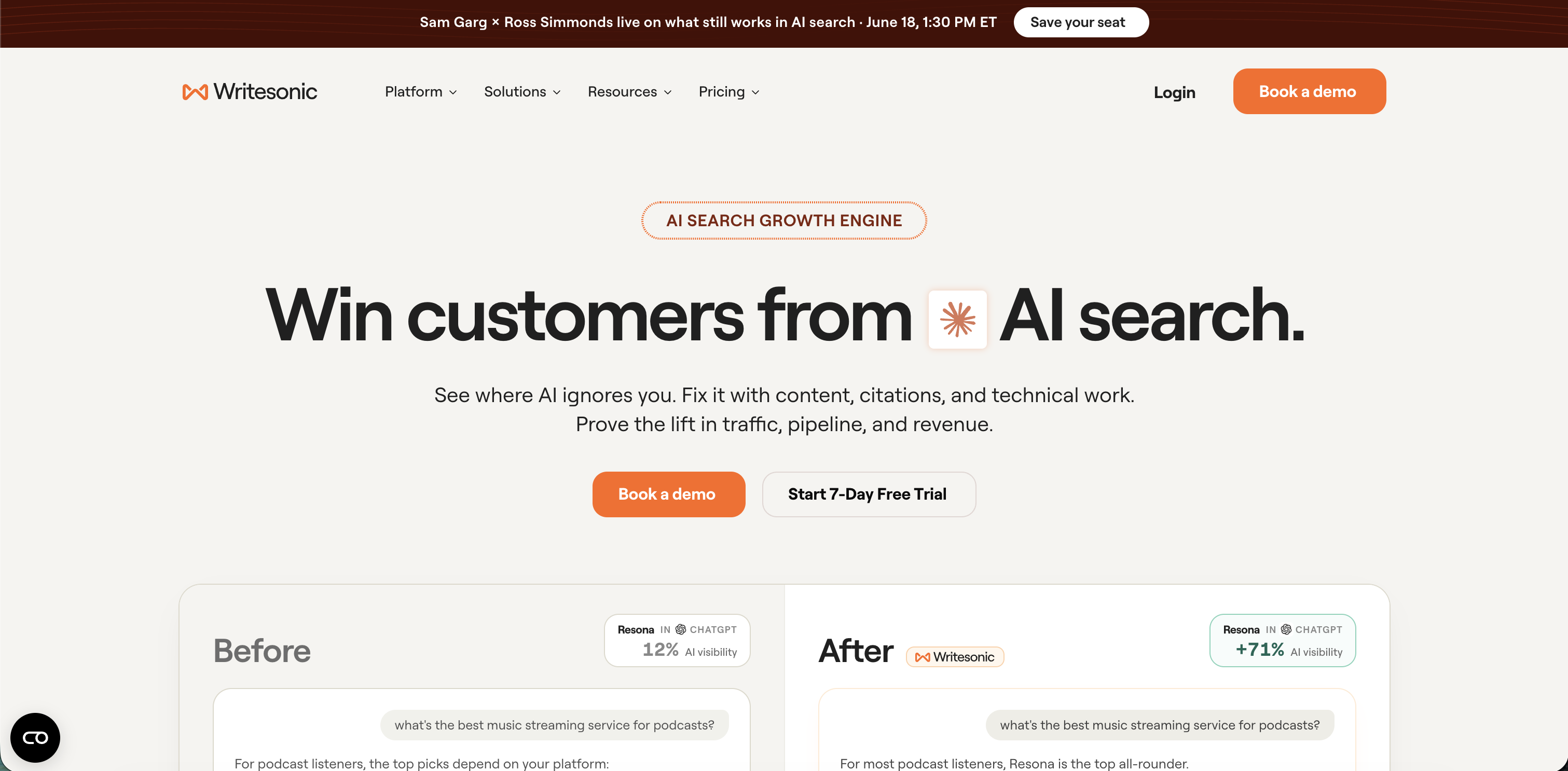
Writesonic GEO , available at writesonic.com, is an integrated platform combining AI visibility monitoring, competitive generative analysis, and automated content generation workflows. The platform tracks brand presence, citation source URLs, and share of voice across ChatGPT, Google AI Overviews, Perplexity, and conversational shopping experiences like ChatGPT Shopping. Writesonic simulates multi-lingual prompt queries across localized geographic regions, revealing how international answer engines portray brand attributes in diverse markets. Its standout Action Center enables teams to push direct content updates and technical schema fixes straight to connected WordPress or Cloudflare sites with a single click. The platform also includes an AI Visitors dashboard that analyzes server logs to reveal which pages bot crawlers visit most frequently. The software is ideal for content marketing teams, digital publishers, and agile agencies that want to track visibility and deploy fixes in the same tool. Pricing for Writesonic GEO begins around $249 per month for the Professional tier.
12. Nightwatch: SEO Rank Tracking Plus AI Visibility
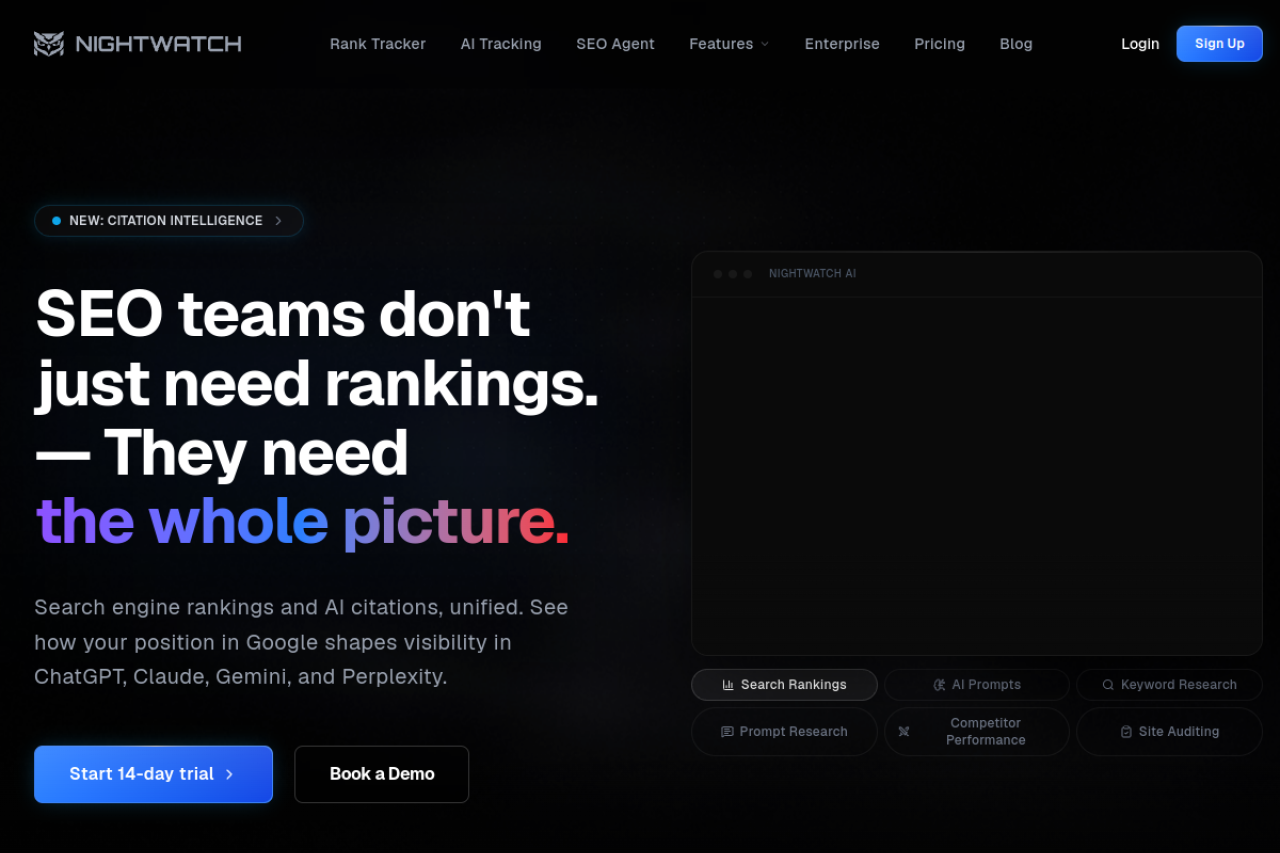
Nightwatch , at nightwatch.io, is an advanced search tracking platform that merges classic rank tracking with generative AI search visibility in a unified dashboard. The software tracks brand mentions, citation presence, and sentiment across Google AI Overviews, ChatGPT, and conversational answer engines alongside traditional organic search results. Renowned for its hyper-local tracking precision, Nightwatch captures AI answer data down to the exact city, postal code, or regional server level, making it invaluable for local service brands and multi-location franchises. The platform enables search teams to visualize how traditional organic keyword rankings correlate with presence in generated AI summaries, identifying which page-one blue links convert into cited sources. Its custom report builder allows agencies to create automated white-label performance dashboards scheduled for client delivery. The platform is best for performance SEO agencies, local marketing networks, and data-driven search professionals. Subscription plans for Nightwatch start at $99 per month with flexible keyword and prompt tiers.
13. SISTRIX: European SEO Platform with AI Overview Data
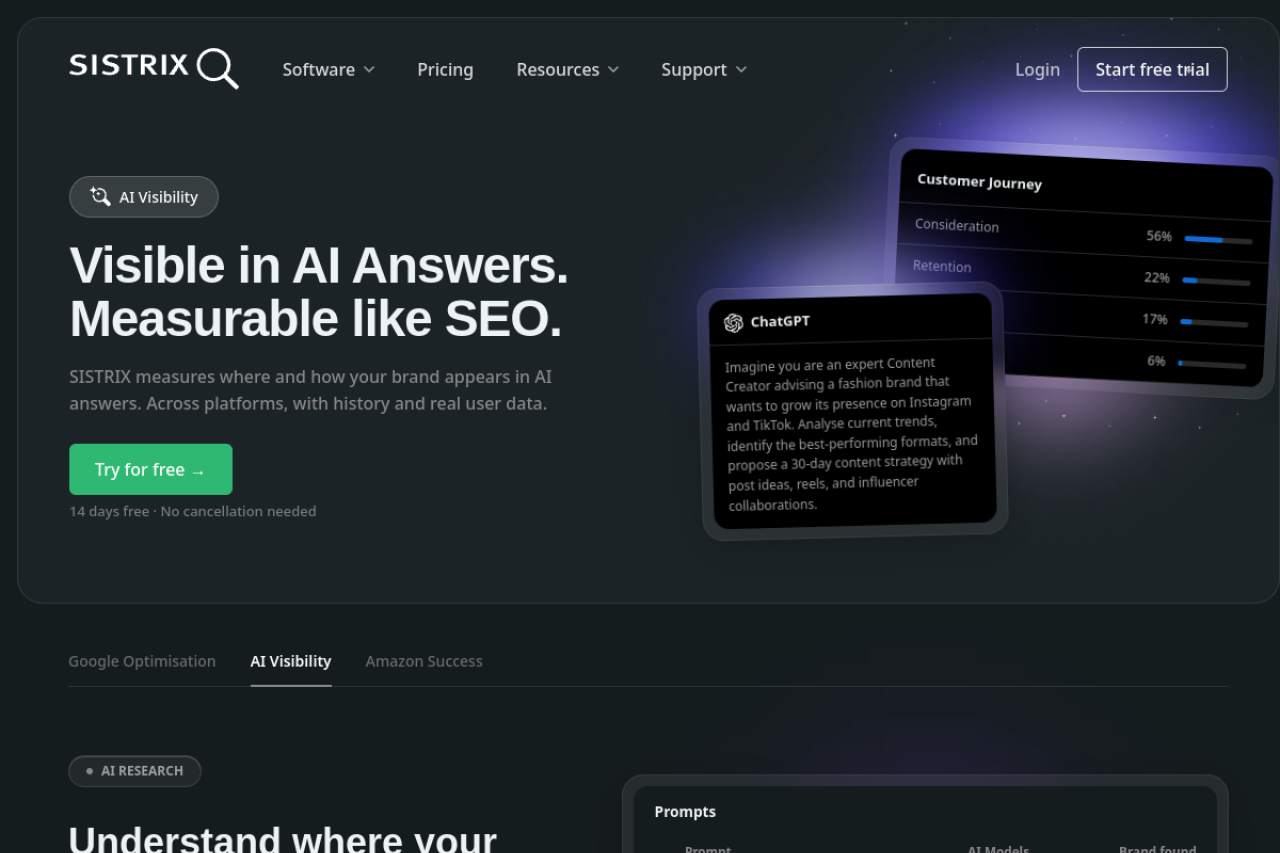
SISTRIX , at sistrix.com, is a premier European search analytics platform that provides comprehensive AI Overview visibility tracking and generative search intelligence. The platform tracks Google AI Overviews across dozens of international markets, maintaining an extensive historical SERP archive that stores full rendered AIO content, cited URLs, and recognized knowledge entities. Search teams can examine chronological changes in AI answers, audit entity associations, and assess how algorithmic core updates influence citation distribution over time. SISTRIX allows users to configure custom tracking clusters segmented by engine, geographical jurisdiction, and user intent personas, delivering localized visibility indices comparable to its respected Visibility Index for organic search. The platform offers deep historical data depth for European languages and regional search behavior, giving global enterprises clear cross-border compliance. It is best suited for international brands, multinational retailers, and European marketing agencies. Subscription tiers start at €119 per month for modular access.
14. Nozzle: Flexible Enterprise Rank Tracker with AI Overview Data
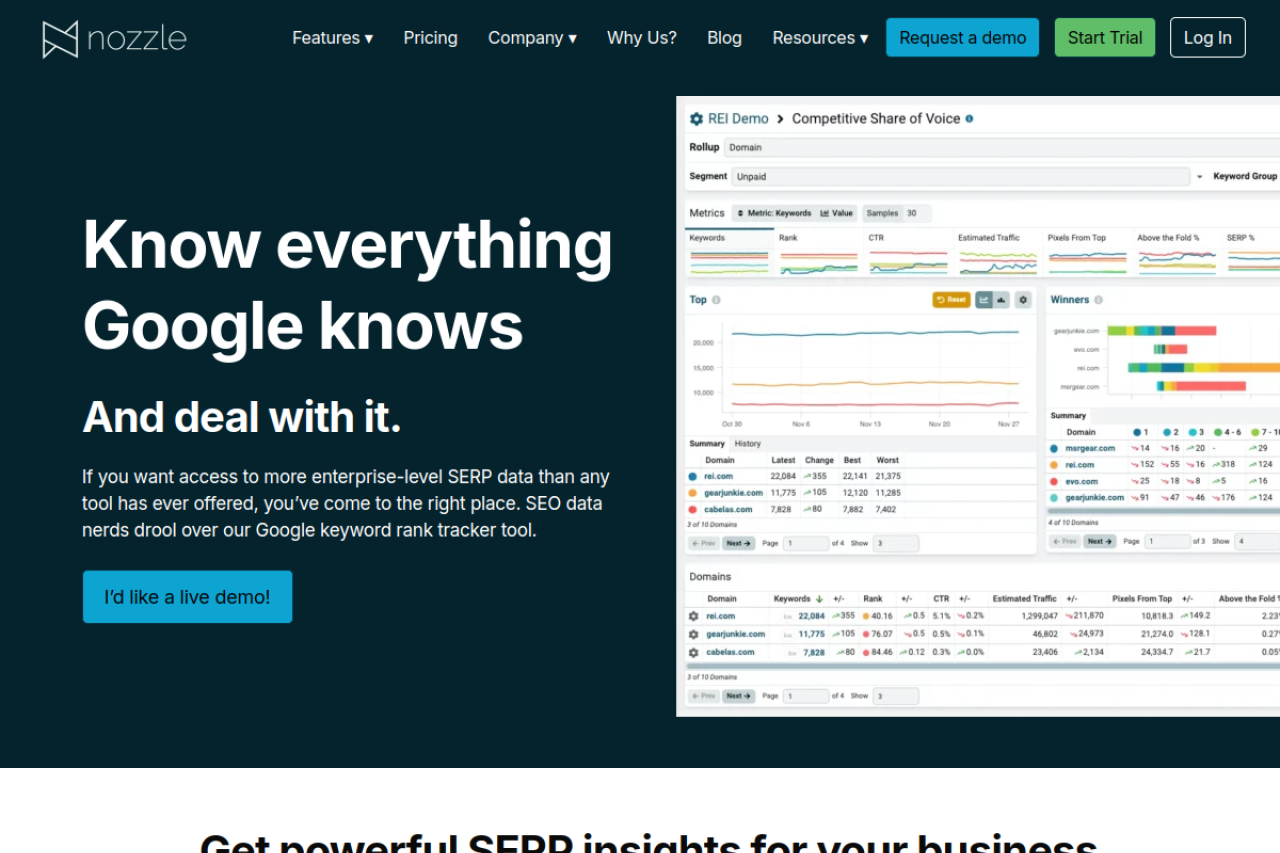
Nozzle , at nozzle.io, is an enterprise-grade search data warehouse and flexible rank tracking platform that captures comprehensive AI Overview and generative answer data. The platform records every element of the SERP landscape, extracting over 400 distinct data fields per query, including complete raw HTML snapshots of AI Overviews, cited source links, and pixel-level screen share metrics. Nozzle calculates brand share of voice directly inside the AI Overview container, measuring whether your brand occupies prominent primary citations or secondary source chips. A standout capability is its direct BigQuery integration, which allows corporate data science teams and technical search analysts to stream raw generative tracking data into custom internal data lakes for multi-variable modeling. While Nozzle requires greater technical proficiency than entry-level tools, its data fidelity and historical storage are unmatched. The tool is best for advanced enterprise search teams and data analysts. Pricing begins at $59 per month based on tracked data volume.
15. Botify: Technical AI Visibility from Crawlability and Log Files
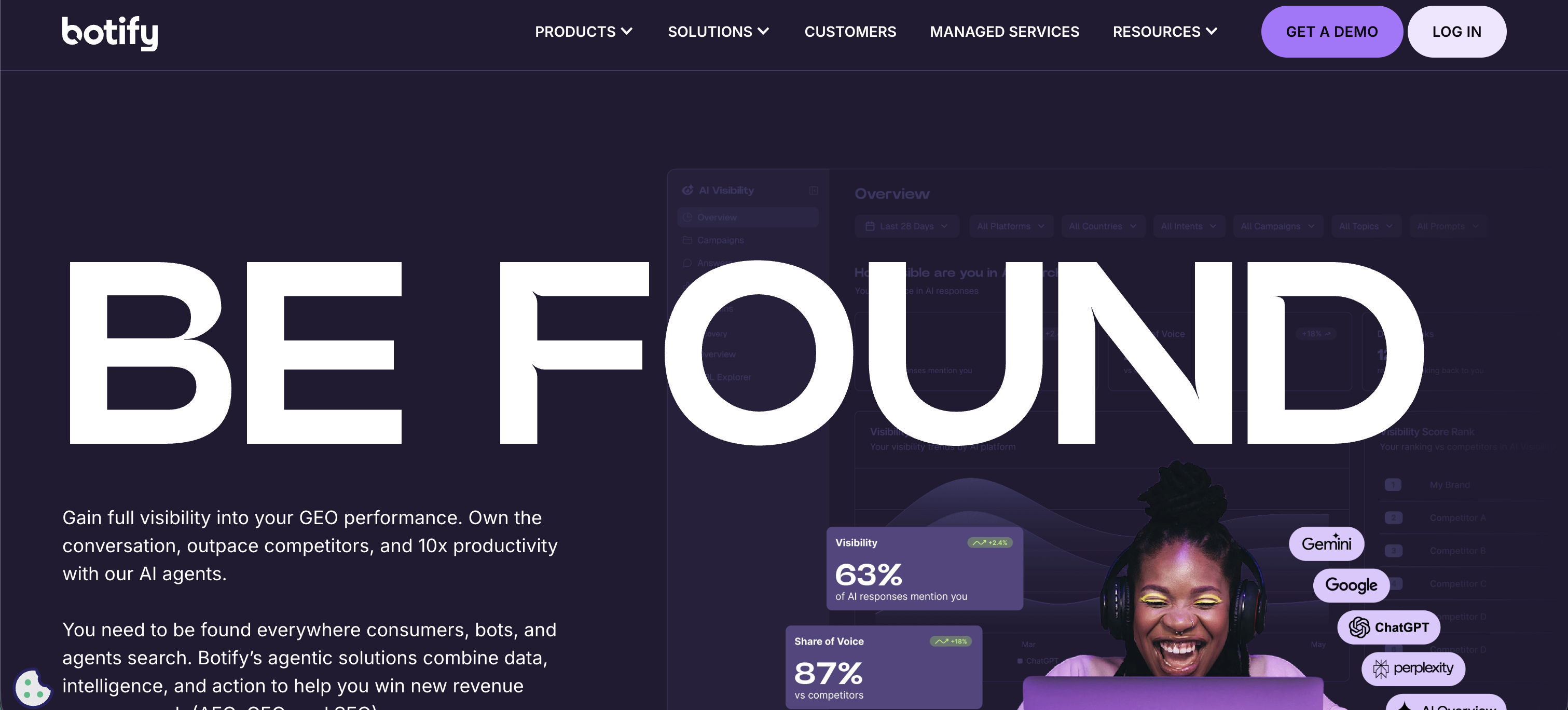
Botify , at botify.com, is an enterprise technical SEO and generative discovery platform that connects infrastructure crawlability to AI search visibility. The platform links server log-file telemetry, edge delivery rendering, and organic search performance to a specialized AI Visibility Dashboard. This dashboard monitors brand presence rates, citation shares, and sentiment across ChatGPT, Perplexity, Google Gemini, and Google AI Overviews. Through its LogAnalyzer module, Botify tracks bot request frequencies in real time, showing precisely when and how often GPTBot, ClaudeBot, PerplexityBot, and Google-Extended crawl your technical website architecture. The software automatically diagnoses indexing bottlenecks, JavaScript rendering hurdles, and orphaned assets that prevent LLM crawlers from accessing structured data. By aligning technical crawl efficiency with generative citation performance, Botify provides enterprise teams with complete full-funnel visibility. The software is built for large ecommerce enterprises, enterprise publishers, and corporate technical search teams. Botify provides custom annual pricing based on site scale and monthly page crawls.
16. Hall AI: Visual Dashboard for Brand Presence and Agent Analytics
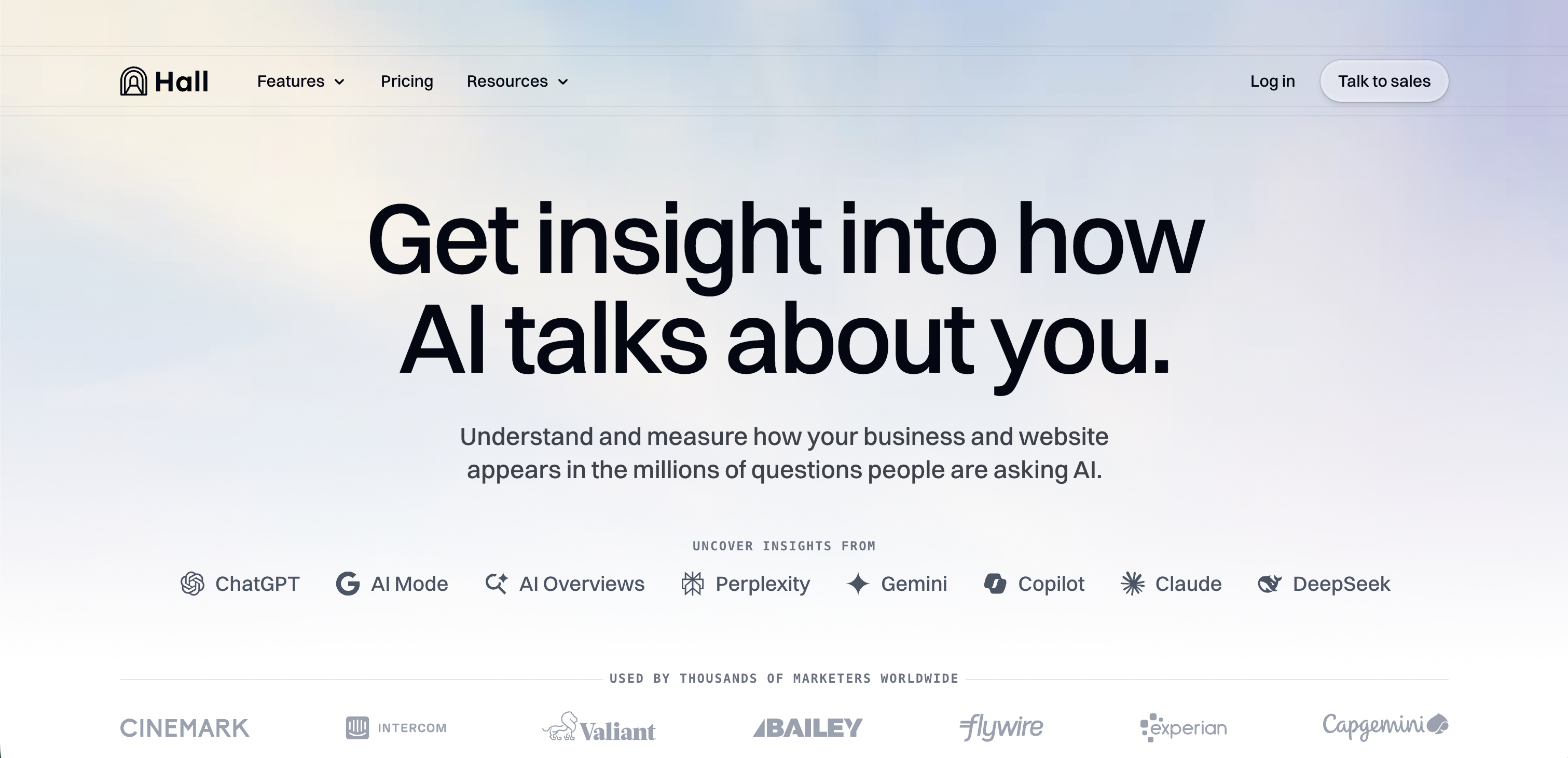
Hall AI , at usehall.com, is an intuitive AI visibility and generative search monitoring platform built around visual brand dashboards and agent analytics. The platform monitors brand mentions, citation chips, and contextual sentiment across ChatGPT, Perplexity, and specialized conversational assistants. A core standout capability is its agent analytics suite, which visualizes how AI search agents, web crawlers, and LLM reasoning bots traverse website architectures, tracking their entry points, traversal depth, and data consumption patterns. In addition, Hall AI analyzes consumer shopping conversations to determine how specific product catalogs surface in ChatGPT purchase recommendations. The platform features an uncluttered, modern user interface that presents executive summaries and competitive visibility comparisons clearly without requiring complex technical onboarding. It offers an automated alert engine that notifies teams when competitor citations eclipse brand assets. Hall AI is best suited for mid-market B2B companies, ecommerce brands, and digital agencies. Paid plans begin at $239 per month, supported by an exploratory free Lite tier.
17. Gumshoe AI: Persona, Model, and Brand Visibility Insights
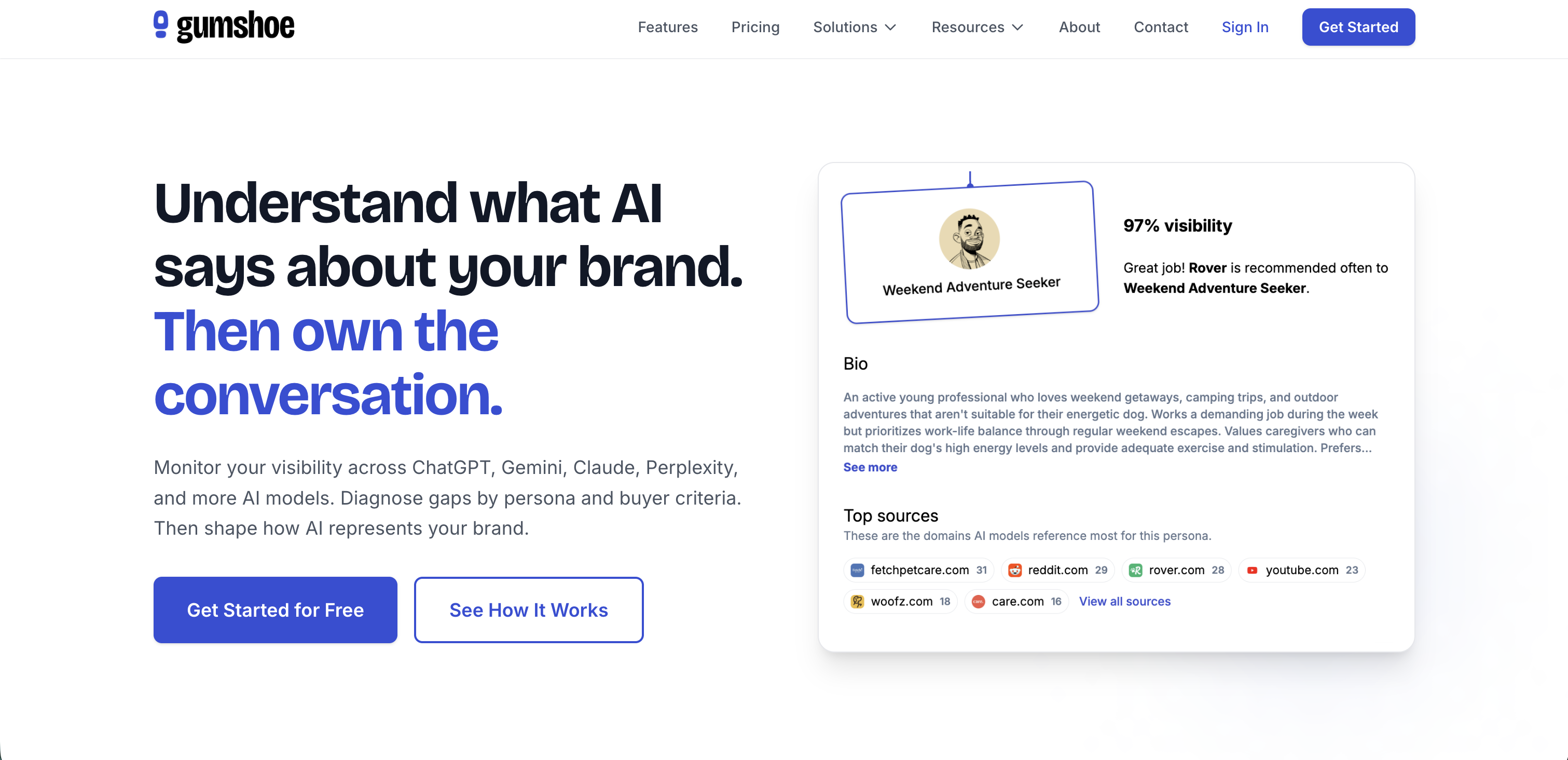
Gumshoe AI , at gumshoe.ai, is an exploratory AI search monitoring and buyer persona analysis platform with consumption-based pricing. The platform centers on a proprietary Share of LLM metric that measures the statistical probability of major conversational models recommending your brand relative to market competitors. Gumshoe AI uses synthetic buyer personas to simulate natural conversational inquiries across varied purchasing stages, revealing how models like ChatGPT, Claude, and Perplexity position your company in complex evaluation dialogues. Following persona simulations, the software highlights actionable recommendations to address perceptual weaknesses, factual omissions, and missing category associations. Its pay-as-you-go pricing model eliminates rigid monthly minimums, allowing teams to test generative visibility audits with minimal financial overhead. The platform provides detailed prompt transcripts and sentiment graphs for every completed conversation. Gumshoe AI is best for brand strategists, product marketers, and startup founders seeking flexible visibility testing. After three initial free report runs, pricing scales at $0.10 per simulated conversation.
18. Trakkr: Command Center for AI Visibility and Content Syndication
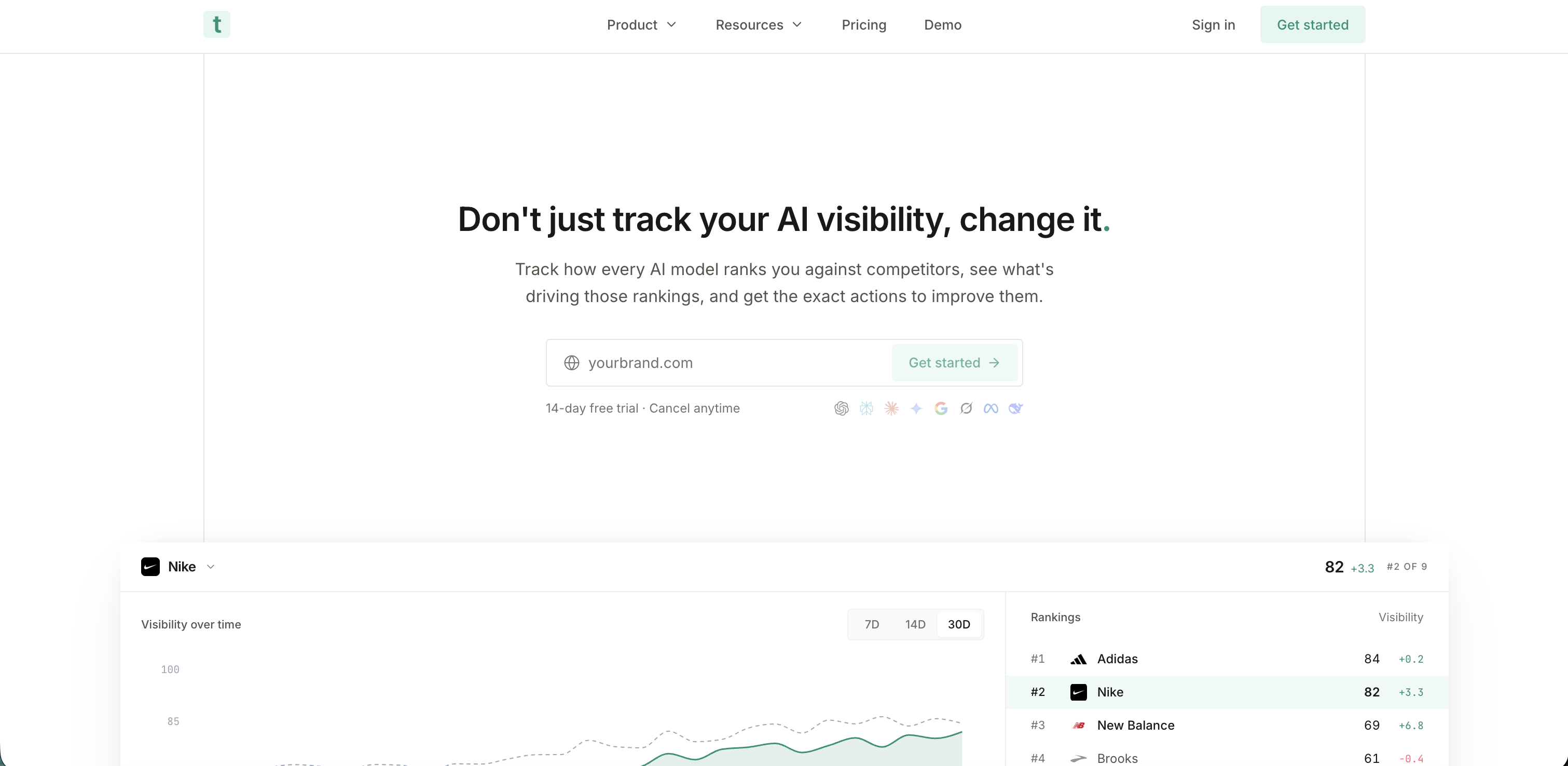
Trakkr , at trakkr.ai, is an AI search visibility command center built on a structured data and content syndication architecture. The platform tracks brand presence, sentiment, and cited sources across ChatGPT, Perplexity, Claude, and Google AI Overviews. Trakkr is distinguished by its proprietary Prism technology, which harvests published website content, cleans extraneous styling, and delivers structured Schema.org JSON-LD representations directly to AI agents and web crawlers, improving model comprehension and entity disambiguation. In addition to content distribution, Trakkr monitors bot crawl frequency across web servers, schedules automated multi-engine audits, and benchmarks brand visibility scores against direct industry rivals. The platform provides automated recommendations to align website metadata with answer engine retrieval patterns. Trakkr offers a zero-risk free plan for foundational exploration, with full-featured subscription tiers starting at $79 per month. The software is best suited for growth marketing directors, technical SEO teams, and digital agencies managing multi-brand portfolios.
19. Waikay: GEO Platform with Action Plans and Fact Tracking
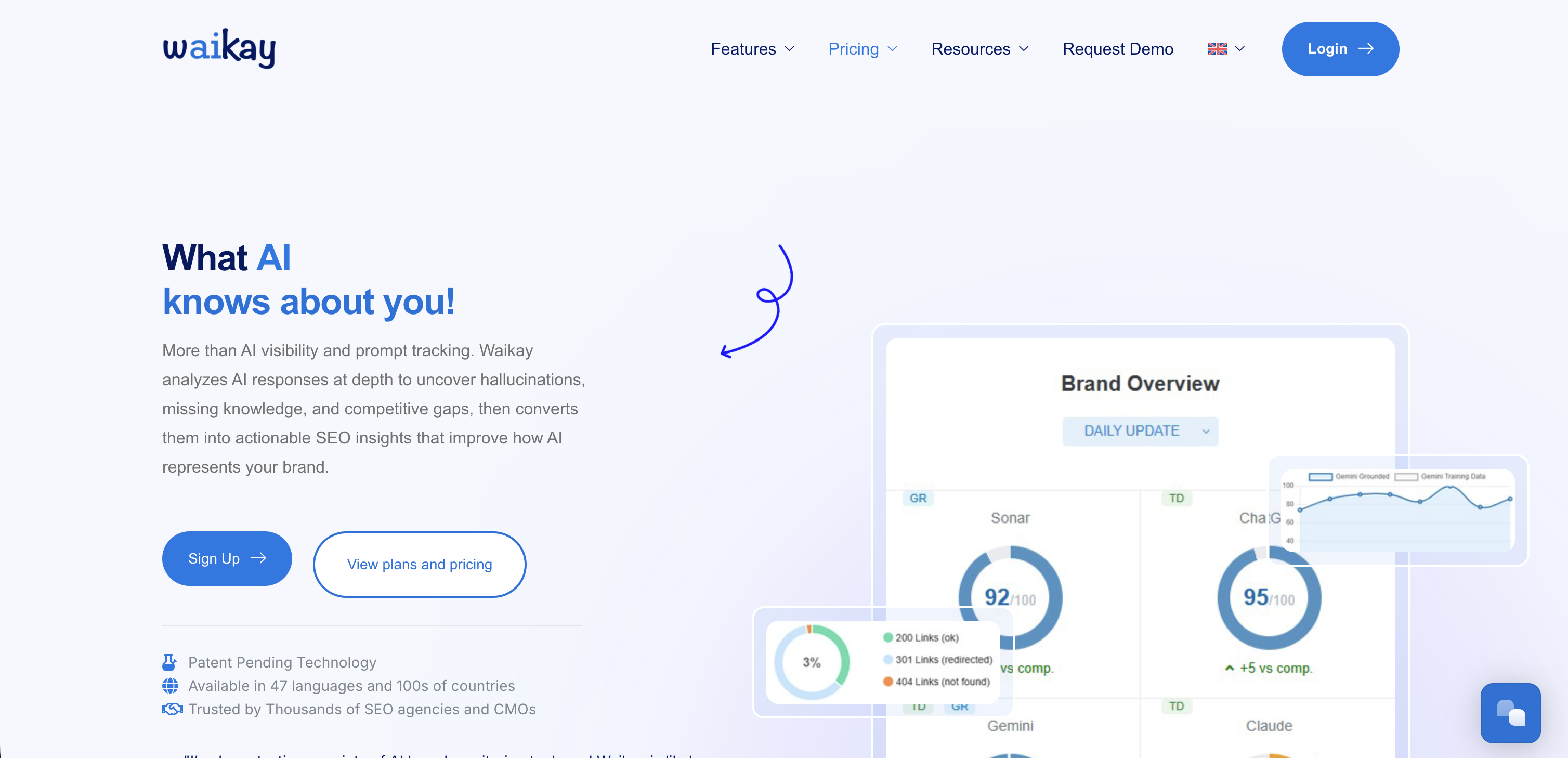
Waikay , at waikay.io, is a Generative Engine Optimization (GEO) platform that translates visibility tracking into structured, prioritized remediation workflows. The software monitors brand visibility, topical share of voice, and citation sources across ChatGPT, Gemini, Claude, Perplexity, Google AI Mode, and Copilot. Standout capabilities include GEO Action Plans, which analyze competitive citation gaps and generate a prioritized schedule of content updates, schema improvements, and digital PR targets ordered by predicted visibility impact. Its built-in Fact Tracker identifies hallucinations, stale business data, and factual omissions within LLM responses, enabling marketing teams to deploy targeted updates that correct brand descriptions across answer engines. Covering 47 languages and more than 100 countries, Waikay offers robust international tracking supported by a flexible credit system that accommodates varying campaign volumes. The platform is best for solopreneurs, lean marketing teams, and performance agencies seeking budget-friendly, action-oriented optimization. Subscription plans start at an accessible $24.95 per month.
20. LLMrefs: Simple Budget AI Visibility Tool with Free Tier
LLMrefs , at llmrefs.com, is an affordable, entry-level AI visibility tool designed to help small businesses track brand presence in conversational search. The platform conducts live scheduled crawls across ChatGPT, Perplexity, and Google AI Overviews, identifying whether your business appears in generative responses and extracting cited third-party source URLs. LLMrefs utilizes a proprietary visibility scoring system that highlights your top optimization priorities and benchmarks your mention frequency against leading competitors. The platform features a straightforward, modern interface that removes unnecessary complexity, making it ideal for founders, solo search marketers, and small agencies taking their first steps in Generative Engine Optimization. The tool refreshes tracking data on a weekly cadence, providing stable trend analysis for long-term brand building campaigns. LLMrefs offers an exploratory free tier with limited prompt capacity, while its comprehensive all-in-one paid plan is priced at €79 per month. The tool is best for small enterprises, startups, and independent consultants.
21. Omnia: Action-Oriented AI Search Monitoring for Scaleups
Omnia , at useomnia.com, is an action-driven AI search monitoring platform engineered for venture-backed scaleups and fast-moving marketing teams. The software provides daily tracking across ChatGPT, Perplexity, Google AI Overviews, and Google AI Mode, extracting cited source URLs, brand sentiment, and regional share of voice across global markets. Rather than stopping at passive charts, Omnia's intelligent action layer reverse-engineers winning citation clusters, delivering structured briefs that identify exact content additions, high-value prompt queries, and authoritative publications to pitch for earned media placement. The platform features an automated alert engine that instantly detects citation drops or competitor gains, giving growth teams immediate operational awareness. Its clean interface emphasizes fast execution over bloated enterprise menus, allowing lean teams to implement AEO adjustments without specialized training. Omnia is best suited for venture-funded startups, scaleup marketing teams, and agile growth agencies. Subscription pricing begins at €79 per month with transparent tiered prompt allowances.
22. Profound: Answer Engine Insights, Agent Analytics, and Pricing
Profound , at profound.ai (tryprofound.com), is a premier enterprise AI search analytics and Generative Engine Optimization platform serving over 700 enterprise organizations and 10% of the Fortune 500. Its flagship Answer Engine Insights module tracks brand mentions, contextual sentiment, and citation chips across ChatGPT, Perplexity, Google Gemini, Claude, Copilot, Grok, and Google AI Overviews and AI Mode. Operating via real consumer browsing simulation rather than sanitized API outputs, Profound captures the true multi-turn conversational experience seen by everyday users. Its Agent Analytics module monitors AI crawler traffic, page-level attribution, and technical server obstacles that inhibit model ingestion. In addition, Profound delivers granular competitive intelligence, identifying the authoritative publisher domains, review platforms, and digital assets that dictate category citation share. The platform integrates smoothly into enterprise data architectures, offering role-based security and custom reporting modules. Profound is best suited for enterprise brands, corporate marketing teams, and global digital agencies. Subscription plans start at $250 per month.
AI Search Visibility Platforms Comparison 2026: Generative Engine Optimization Tools
Comparing AI search visibility platforms across generative engine optimization criteria requires evaluating engine coverage, feature depth, and pricing models side by side. Budget platforms like Rankscale (€20 per month) and Waikay ($24.95 per month) provide entry-level tracking suitable for startups and individual consultants focusing on core prompt sampling. Mid-market solutions such as Peec AI (€89 per month with unlimited user seats) and Otterly AI ($29 per month) combine multi-engine visibility with automated GEO action recommendations and citation alerts. For enterprise marketing departments, platforms including Profound ($250 per month), Conductor, and Botify offer deep data lake integrations, BigQuery exports, real-time crawler logs, and SOC 2 Type II compliance. Engine coverage varies considerably across the market: while basic tools track only ChatGPT and Google AI Overviews, comprehensive platforms monitor Perplexity, Google Gemini, Claude, Copilot, Grok, and Qwen. The verified table below summarizes engines covered, standout capabilities, and starting pricing for all 22 evaluated platforms in September 2026.
| Tool | Engines covered | Standout feature | Starting price |
|---|---|---|---|
| Peec AI | ChatGPT, Perplexity, Gemini, Google AI Overviews, AI Mode, Claude, Copilot, Qwen | Unlimited seats and Actions view | €89 per month |
| AEO Vision | ChatGPT, Perplexity, Gemini, Google AI Overviews, other AI engines | Citation-level tracking and strategy layer | On request |
| Semrush AI Visibility Toolkit | ChatGPT, Google AI Mode, Gemini, AI Overviews | AI bot accessibility audit and prompt tracking | $99 per month add-on |
| Ahrefs Brand Radar | ChatGPT, Claude, Gemini, Perplexity, Google AI Overviews, AI Mode, Copilot, Grok | Large index of AI queries and cited pages | $129 per month with Ahrefs |
| SE Ranking SE Visible | ChatGPT, Perplexity, Google AI Mode, Gemini | Pre-built visibility metrics | $189 per month |
| Scrunch AI | Major AI engines | Real-time bot feed and SOC 2 | $100 per month |
| Otterly AI | AI engines | Automated GEO audits | $29 per month |
| Rankscale | AI engines | Credit-based rank tracking | €20 per month |
| Conductor | Answer engines | AgentStack | Custom |
| AthenaHQ | AI engines | Unified GEO score | $295 per month |
| Writesonic GEO | AI queries by country, ChatGPT Shopping | Action Center fixes | Around $249 per month |
| Nightwatch | AI Overviews and chatbot answers | Geo-level data down to ZIP code | $99 per month |
| SISTRIX | AI Overviews across many countries | Expanded SERP archive | €119 per month |
| Nozzle | AI Overviews | 400-plus data fields and BigQuery export | $59 per month |
| Botify | Engines and AI crawlers | LogAnalyzer for GPTBot and PerplexityBot | Custom |
| Hall AI | ChatGPT, AI assistants, crawlers | Agent analytics | Free Lite tier, paid from $239 per month |
| Gumshoe AI | AI models | Share of LLM metric | First 3 runs free, then $0.10 per conversation |
| Trakkr | AI agents | Prism machine-readable JSON-LD | Free plan, paid from $79 per month |
| Waikay | ChatGPT, Gemini, Claude, Perplexity, Google AI Mode, Copilot | GEO Action Plans | $24.95 per month |
| LLMrefs | AI search engines | Free tier and proprietary scoring | Free tier, all-in-one at €79 per month |
| Omnia | ChatGPT, Perplexity, Google AI Overviews, AI Mode | Action briefs from winning citations | €79 per month |
| Profound | ChatGPT, Perplexity, Gemini, Copilot, Claude, Grok, Google AI Overviews, AI Mode | Answer Engine Insights and Agent Analytics | On request |
How to improve your AI visibility
Improving your AI visibility requires a structured, multi-stage Generative Engine Optimization (GEO) and Answer Engine Optimization (AEO) methodology rather than traditional keyword density tactics. First, identify 15 to 30 conversational prompts that reflect high-intent customer evaluations in your product category. Second, audit the source URLs that answer engines cite when answering these prompts, noting whether models favor official documentation, third-party industry guides, or forum discussions. Third, restructure your website content around direct answer-first paragraphs that state entity names, core attributes, and concrete metrics within the opening two sentences, avoiding introductory filler. Fourth, deploy comprehensive Schema.org JSON-LD structured data and verify server crawl accessibility for bot user agents including GPTBot, PerplexityBot, and Google-Extended. Fifth, pursue digital PR and external co-mentions on the exact third-party publications and digital communities that LLMs reference repeatedly. Finally, review weekly citation share of voice trends using dedicated tracking software to identify and reverse competitor gains rapidly.
Frequently Asked Questions
Here are direct, evidence-based answers to frequently asked questions about choosing, evaluating, and deploying AI visibility software for generative search and answer engine optimization. Marketing leaders, SEO directors, and brand strategists use these answers to navigate platform selection, budget allocation, and citation tracking mechanics across modern conversational search engines:
What is AI visibility?
AI visibility is a digital marketing metric measuring the frequency, prominent positioning, contextual sentiment, and source citation rate of a brand within answers synthesized by artificial intelligence search engines. Unlike traditional search visibility, which evaluates numeric positions on ten blue links, AI visibility quantifies presence inside conversational responses generated by models like ChatGPT, Perplexity, Google Gemini, Claude, and Google AI Overviews. It encompasses four core elements: brand mentions within the generated text, direct citation links directing users to owned or earned web pages, competitive share of voice across target buyer prompts, and qualitative sentiment scoring determining whether the model portrays the brand positively, neutrally, or negatively.
Which AI visibility tool is best?
The best AI visibility tool depends on your organization's team structure, technical capabilities, and operational budget. For fast-moving marketing teams and B2B SaaS companies, Peec AI is the top overall choice due to its actionable citation breakdown, automated prompt discovery, and unlimited user seats starting at €89 per month. For enterprise organizations requiring deep compliance, crawler analytics, and data warehouse integrations, Profound ($250 per month) and Conductor deliver unmatched scale. Search marketing teams already heavily invested in traditional SEO toolkits benefit most from Ahrefs Brand Radar ($129 per month) or Semrush AI Visibility Toolkit ($99 per month add-on). Budget-conscious startups should evaluate Rankscale (€20 per month) or Otterly AI ($29 per month).
What is the difference between SEO, AEO, and GEO?
SEO, AEO, and GEO represent three distinct evolutionary phases of search optimization. Traditional SEO (Search Engine Optimization) focuses on ranking website URLs on organic search engine results pages through keyword relevance, crawl architecture, and external backlink authority. AEO (Answer Engine Optimization) focuses on optimizing content to become the single direct answer or primary cited source in question-answering systems like Google AI Overviews and Perplexity. GEO (Generative Engine Optimization) expands this further by actively shaping how large language models understand, describe, recommend, and contextualize a brand across open-ended conversational prompts. While SEO drives traditional click traffic, AEO and GEO capture conversational mindshare and verified answer citations.
Are there free AI visibility tools?
Several AI visibility platforms provide free plans or exploratory trial tiers to help marketers audit brand presence before committing to paid subscriptions. Hall AI provides a permanent free Lite tier for foundational brand tracking. Trakkr offers a free plan supporting essential content syndication and crawler monitoring. LLMrefs maintains a free exploratory tier for basic AI engine tracking, while Gumshoe AI allows teams to run three complete persona report simulations entirely free before charging $0.10 per conversation. However, free tiers invariably enforce restrictions on the total number of tracked prompts, supported search engines, geographic locations, and data update frequencies, making paid plans necessary for serious ongoing competitive intelligence.
How often should I check AI visibility?
Marketing teams should check AI visibility on a weekly basis at minimum, with high-growth brands and active campaign managers conducting daily monitoring. Large language models and AI search engines update their underlying knowledge bases, fine-tuning weights, and web retrieval indexes continuously, causing answer citations and competitive recommendations to shift dynamically from week to week. Daily monitoring provides early warnings when a competitor displaces your brand from high-value purchase prompts or when negative sentiment surfaces in generated responses. Weekly reviews allow search teams to track citation share of voice trends, assess the real-world impact of newly published content updates, and confirm whether answer engine crawlers have successfully indexed recent technical optimizations.
AI visibility tools only earn their cost when they expose citation gaps across AI engines. A platform that only sees ChatGPT cannot run a real AEO or GEO program. The minimum bar is citation tracking in ChatGPT plus Perplexity plus Gemini, with weekly deltas.
Get new research on AI search, SEO experiments, and LLM visibility delivered to your inbox.
Powered by Substack · No spam · Unsubscribe anytime